
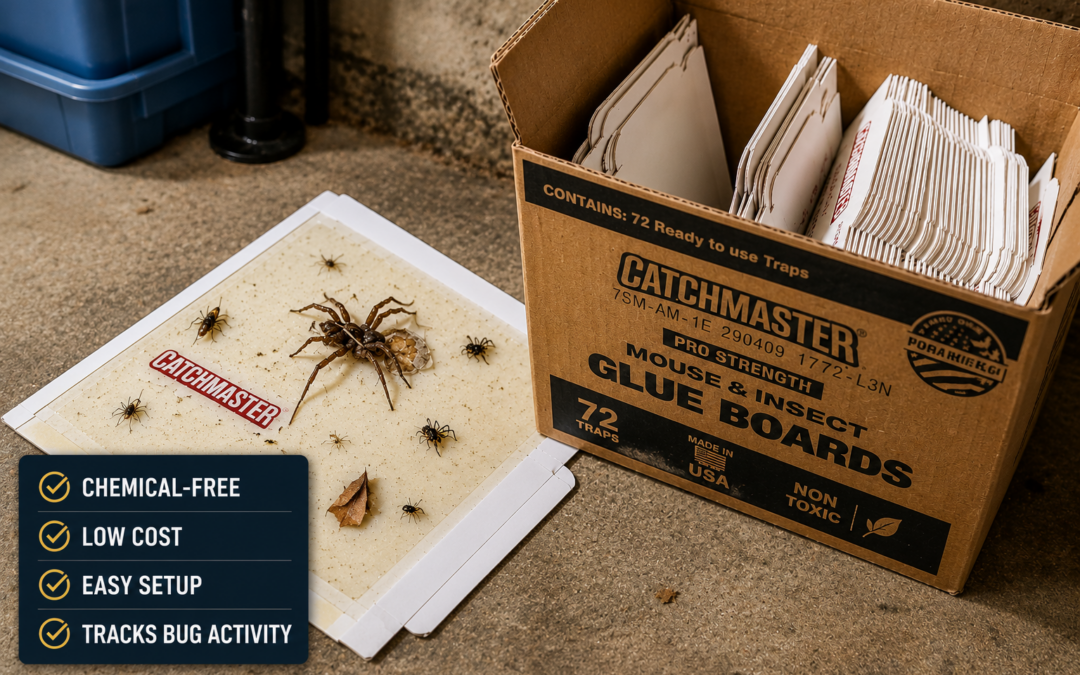
But for many families, there’s one obstacle that can make a basement less appealing: bugs.
Spiders, crickets, and other crawling insects seem to find their way into even the cleanest basements. For kids, spotting a spider can be enough reason to avoid the space entirely.
One surprisingly simple solution is using sticky mouse traps.
Most people think of these traps as a way to catch mice, but they can also be effective for monitoring and catching spiders and other crawling insects. After placing a few around a basement, it quickly becomes clear just how much activity is happening along walls, behind storage bins, and near utility areas.
One of the biggest advantages is that sticky traps don’t require sprays, foggers, or other chemicals. They work around the clock and provide a simple way to see where insects are traveling. In many cases, they can also help identify problem areas that may need additional attention, such as gaps around doors, cracks in the foundation, or damp areas near a sump pump.
Placement is important. Traps tend to work best when placed along walls, behind furniture, near storage shelves, or in utility areas where insects naturally travel. It’s also a good idea to put them somewhere they won’t accidentally be stepped on.
For households with pets, extra caution is needed. Curious dogs and cats can sometimes get stuck to the adhesive surface. If pets have access to the basement, consider placing traps in closets, behind storage containers, or in other locations where they can’t easily be reached.
Another helpful tip is to replace the traps regularly. Over time, dust, dirt, and captured insects can reduce their effectiveness. Checking them every few weeks makes it easy to see whether they’re still doing their job.
Sticky traps won’t solve every pest problem, and they’re not a replacement for addressing larger issues such as moisture or structural entry points. However, they’re an inexpensive and chemical-free tool that can help reduce bug sightings and make a basement feel more comfortable for the entire family.
Sometimes the simplest solutions end up making the biggest difference.