
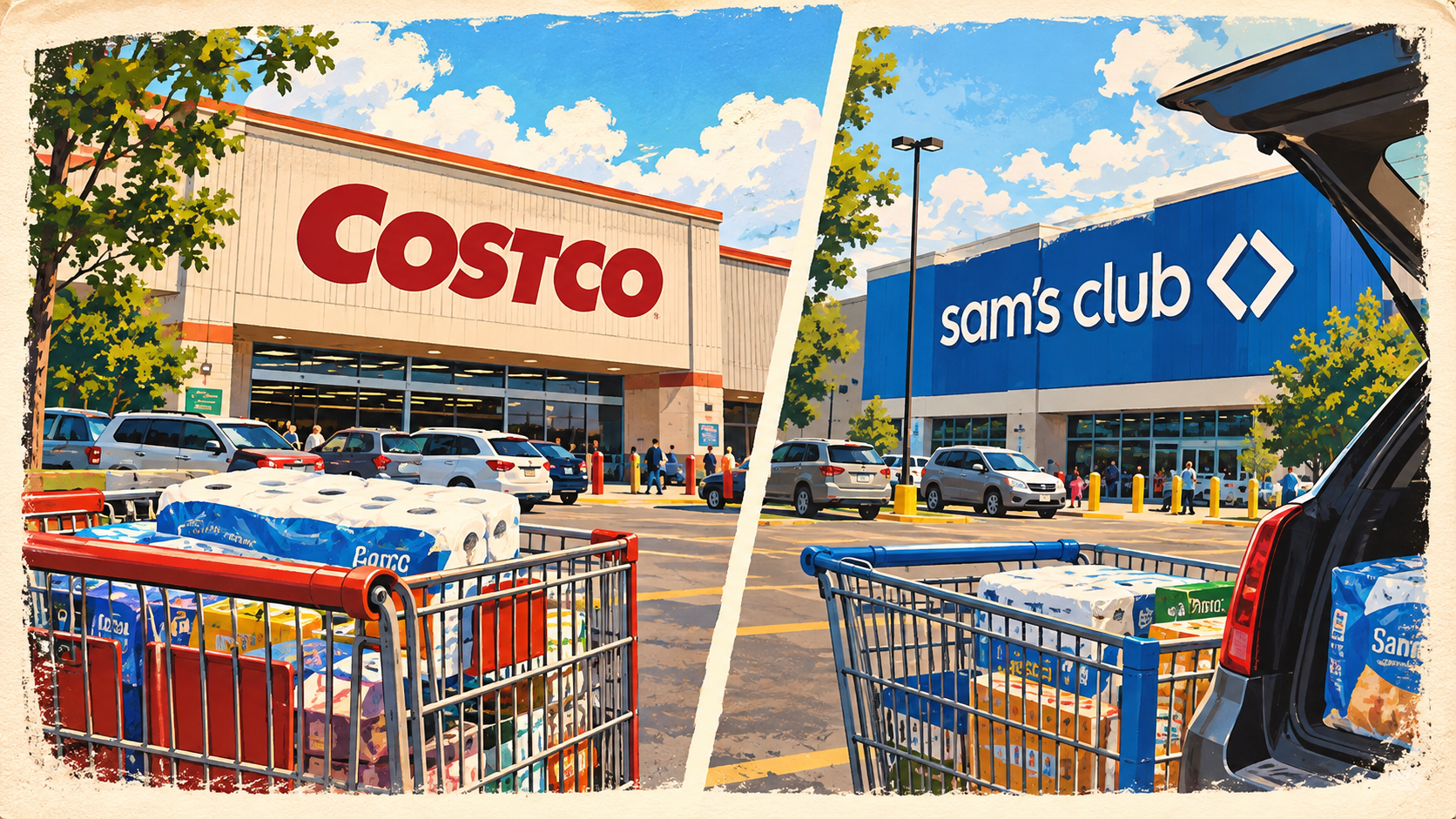
Costco and Sam’s Club are often compared based on membership prices, product selection and food-court favorites. Those things matter, but they do not tell you much about what it is actually like to complete a shopping trip.
For this comparison, I wanted to go deeper into two specific parts of the experience: checking out and buying gasoline. That includes the mix of cashiers and self-checkout lanes, accepted payment methods, receipt checks, fuel-station layouts, gas prices and fuel quality.
The short version is that neither club wins across the board. Costco provides the better traditional checkout experience, while Sam’s Club makes it faster to leave the building. Their gas stations are close enough that I consider the category a tie.
Checkout Lanes: Costco Wins the Traditional Experience
The biggest difference between the two clubs is how they approach the checkout process.
At the Sam’s Club locations I have visited, most lanes are dedicated to self-checkout, with a much smaller area reserved for traditional cashiers. This works well if you like scanning your own items or using Scan & Go in the Sam’s Club app. However, members who want to pay with cash or prefer having an employee handle the transaction may have fewer lanes to choose from and a longer wait.
Costco generally maintains a more traditional checkout setup, with more staffed registers available alongside self-checkout. Lines can still become long during busy periods, but the process feels better organized for customers who want a cashier.
This category ultimately comes down to personal preference. Sam’s Club provides more ways to avoid a cashier altogether, while Costco offers the stronger conventional register experience. For my typical shopping trip, Costco gets the win.
Winner: Costco
Payment Options: Both Have Frustrating Limitations
Sam’s Club has the advantage when it comes to credit-card choice. According to the company’s current payment policy, its U.S. clubs accept all major credit cards, including Visa, Mastercard, American Express and Discover. Cash, checks, debit cards, Walmart and Sam’s Club gift cards, SNAP/EBT and Sam’s Cash are also accepted where eligible.
Costco is more restrictive with credit cards inside its U.S. warehouses. It accepts Visa credit cards, most PIN-based debit and ATM cards, Costco Shop Cards, cash, checks, EBT and several other payment types.
Sam’s Club’s lack of ordinary tap-to-pay support at the register remains an inconvenience for shoppers who depend on Apple Pay or a contactless card. The Sam’s Club app and Scan & Go provide a separate digital checkout option, but that is not the same as tapping your preferred wallet at a standard payment terminal.
So, Sam’s Club accepts a wider range of major credit cards but does not offer standard Apple Pay support at the register. Costco, meanwhile, restricts warehouse credit-card payments to Visa. Each club has a frustrating limitation, which is why neither gets the win.
Verdict: Both fail
Leaving the Store: Sam’s Club Wins Easily
Both clubs verify purchases before members leave, but the experience can be very different.
Costco usually relies on an employee to review the receipt and visually inspect the cart. The system is straightforward, but a line can form near the exit when the store is busy or several customers have large orders.
Sam’s Club has been rolling out AI-powered exit technology that combines computer vision and digital tools to confirm that items in a cart were paid for. Instead of stopping every customer for a traditional item-by-item receipt review, the blue exit arches scan the cart as the member walks toward the door. An employee can then focus on transactions that require additional attention.
In practice, this can make leaving Sam’s Club noticeably faster. It also fits with the company’s broader Scan & Go strategy, which lets members scan products and pay through the app without using a checkout lane.
This is not a close category. Sam’s Club has taken one of the most annoying parts of warehouse-club shopping and made it quicker.
Winner: Sam’s Club
Costco vs. Sam’s Club Gas Stations
The fuel stations share several important features. Both are designed around one-way traffic, which helps keep cars moving in an orderly direction. The pumps also have extra-long hoses, so it generally does not matter which side of the vehicle contains the fuel door. You can pull into the shortest suitable lane instead of waiting only for a pump on one particular side.
Neither club accepts cash directly at the pump. Costco’s current U.S. gas-station payment options include Visa cards, most PIN-based debit and ATM cards, and Costco Shop Cards. Sam’s Club fuel centers accept eligible cards and Walmart or Sam’s Club gift cards, although accepted payment options can vary by location. Sam’s Club members can also use the app’s Scan & Go Fuel feature at participating stations.
Pump Availability Lights Give Costco an Edge
Costco has added red and green indicator lights at many of its gas stations. These lights show drivers which pumps are occupied and which are available, including pumps that may be difficult to see from the back of a long line.
It sounds like a small improvement, but it makes choosing a lane easier and helps traffic move more efficiently. Sam’s Club fuel stations are generally easy to navigate as well, but Costco’s availability lights are a practical advantage.
Gas Prices: Sam’s Club May Be Slightly Cheaper
In my local comparison, Sam’s Club had a slight edge on price. Both clubs were roughly 30 cents per gallon cheaper than nearby conventional gas stations, although prices can change daily and results will vary considerably by region.
That means it is worth comparing the actual price difference before driving out of your way. Saving two or three cents per gallon probably does not justify a special trip. A larger discount may be worthwhile, especially if the fuel station is already part of your regular shopping route.
Fuel Quality: Costco Has the Advantage
Price is only one part of the value equation. Costco’s Kirkland Signature gasoline is certified as TOP TIER fuel. The TOP TIER program sets detergent and performance standards supported by major automakers, and all octane grades sold by an approved retailer must meet its requirements.
Sam’s Club fuel can still be a perfectly reasonable choice, but Sam’s Club is not currently listed among the nationally approved TOP TIER gasoline brands. If the prices are nearly identical, Costco’s fuel-quality certification gives it a meaningful advantage. If Sam’s Club is noticeably cheaper, some drivers may decide that its lower price matters more.
Final Score: Costco vs. Sam’s Club
Here is how the four categories break down:
- Traditional cash-register experience: Costco wins
- Payment options: Both fail
- Receipt check and store exit: Sam’s Club wins
- Gasoline: Tie
Costco offers the better experience for shoppers who prefer staffed checkout lanes and certified TOP TIER gasoline. Sam’s Club is stronger for members who want broad credit-card acceptance, app-based checkout and a much faster exit from the building.
There is no universal winner because the right choice depends on which inconveniences bother you most. If you value a traditional register and fuel quality, Costco probably has the edge. If you prefer self-checkout, Scan & Go and a quicker exit, Sam’s Club may be the better fit.
Which warehouse club gives you the better overall experience?